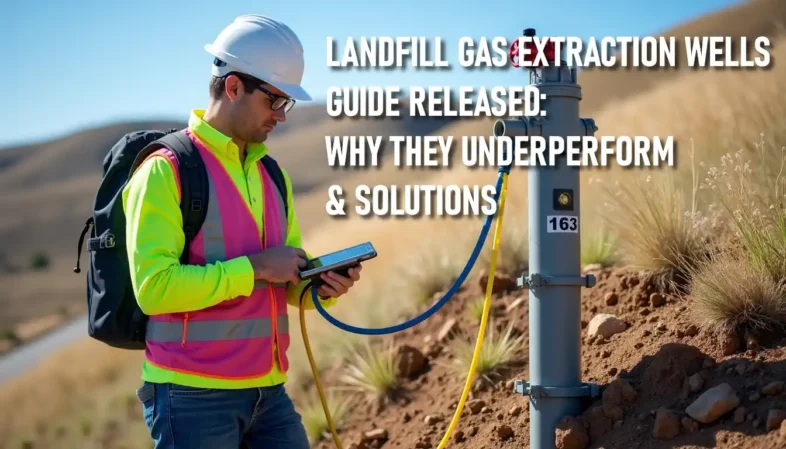
Inadequate landfill gas extraction wells contribute to up to 50% of the methane generated in landfills that escapes capture, according to recent studies, contributing significantly to greenhouse gas emissions.
IPPTS Associates has released a 60-page practitioner-level guide titled ‘Landfill Gas Extraction Well Design Techniques & Methods' that addresses this efficiency gap. The guide explains common reasons for extraction well underperformance and offers practical engineering solutions to enhance their effectiveness, controllability, and long-term maintainability for landfill design engineers and consultants.
More information is available at https://landfill-gas.com/landfill-gas-extraction-well-design-guide
Landfill gas extraction wells often fail not in theory but in practice. Leachate buildup and ground settlement damage emerge as primary failure mechanisms. Leachate can also build up in wells, blocking gas flow and reducing the radius of influence of wells, whilst differential settlement within landfills causes damage to pipework, leading to leaks, blockages, and reduced gas recovery efficiency.
Industry reports and expert opinion have documented these field problems, necessitating practitioner-level guidance that goes beyond generic regulatory frameworks. The U.S. Environmental Protection Agency provides guidance on landfill gas collection and control systems, emphasising proper design and operation to maximise gas capture and minimise emissions, yet the gap between regulatory intent and effective implementation persists.
Steve Last, a Chartered Civil and Environmental Engineer with over 30 years of experience in landfill engineering and gas management, authored the guide to address this gap. The 60-page resource focuses on practical design decisions rather than generic theory, covering bore depth, perforation requirements, radius of influence, leachate extraction, condensate, sealing, horizontal collectors, installation quality control, wellfield balancing, and long-term performance.
This scope distinguishes the guide from existing literature by concentrating on the engineering choices that determine whether extraction wells remain effective, controllable, and maintainable throughout their operational life.
The guide serves landfill managers, consultants, design engineers, regulators, and gas-to-energy developers, bridging the gap between regulation and effective implementation.
Methane is a potent greenhouse gas with a global warming potential 28 to 30 times greater than carbon dioxide over a 100-year period, according to environmental statistics, making effective gas extraction a climate action tool. By improving well design and operation, the guide supports regulatory compliance in the UK and EU contexts whilst helping operators reduce methane emissions and enhance energy recovery potential from landfill sites.
The guide's core promise centres on improving well effectiveness, controllability, and maintainability over the long term, not just initial installation. Practical considerations include differential settlement accommodation, leachate drainage strategies, well-head design, and wellfield balancing that ensure systems remain operational through the landfill's life cycle.
Designs that account for ground movement, prevent air ingress, and manage liquids effectively reduce the risk of system failure and costly repairs whilst maintaining consistent methane capture rates.
The guide is available now as a 60-page resource for landfill design engineers and consultants seeking detailed engineering guidance for current and future projects. For more information about IPPTS Associates, visit https://ippts.com/
Company: IPPTS Associates City: Shrewsbury Address: 11 Adswood Grove Website: https://ippts.com/ Phone: +447875170878 Email: steve@ippts.com